
I Tested Carbon Fiber 3D Printer Filament: My Honest Review of Strength, Print Quality, and Best Uses

I’ve always been fascinated by materials that push 3D printing beyond the ordinary, and carbon fiber 3D printer filament is one of the most exciting examples. It combines the lightweight strength of carbon fiber with the versatility of 3D printing, opening the door to parts that are not only durable but also impressively precise and performance-driven. Whether I’m thinking about functional prototypes, mechanical components, or projects that need a tougher finish, this filament stands out as a material that brings serious capability to the print bed.
I Tested The Carbon Fiber 3d Printer Filament Myself And Provided Honest Recommendations Below

ELEGOO Carbon Fiber PLA Filament 1.75mm Black 1KG, PLA-CF Strong 3D Printer Filament Dimensional Accuracy +/- 0.02mm, 1kg Cardboard Spool(2.2lbs) Fits for Most FDM 3D Printers
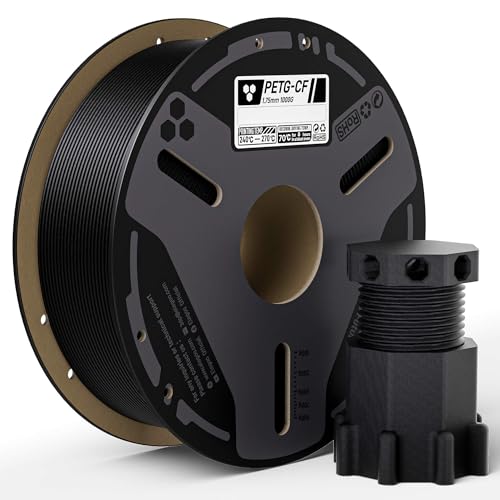
ELEGOO Carbon Fiber PETG Filament 1.75 mm Black 1KG, High Strength & Rigidity PETG-CF 3D Printing Filament, Abrasion Resistance for Functional Parts, 1KG(2.2lbs) Spool Fits for Most FDM 3D Printers

Polymaker Fiberon PA612-CF15 Carbon Fiber Nylon Filament 1.75mm Black 0.5kg, Fiberon PA612-CF15 Strong & Low Moisture Sensitive Nylon 1.75mm 3D Printing Filament

FLASHFORGE Carbon Fiber PETG Filament 1.75mm, Carbon Fiber PETG 3D Printer Filament, 1KG Spool Dimensional Accuracy +/- 0.02mm, Lightweight & Heat-Resistant & Moisture Free (Black)

LANDU Carbon Fiber PLA Filament 1.75mm Black 1KG, PLA-CF Strong 3D Printer Filament Dimensional Accuracy +/- 0.02mm, 1kg Cardboard Spool(2.2lbs) Fits for Most FFF 3D Printers
1. ELEGOO Carbon Fiber PLA Filament 1.75mm Black 1KG, PLA-CF Strong 3D Printer Filament Dimensional Accuracy +– 0.02mm, 1kg Cardboard Spool(2.2lbs) Fits for Most FDM 3D Printers
I grabbed the ELEGOO Carbon Fiber PLA Filament 1.75mm Black 1KG, PLA-CF Strong 3D Printer Filament Dimensional Accuracy +/- 0.02mm, 1kg Cardboard Spool(2.2lbs) Fits for Most FDM 3D Printers because I wanted my prints to stop looking like they survived a tiny earthquake. I was pleasantly surprised by how stiff and sturdy the parts came out, and the carbon fiber reinforcement really gives them that “I mean business” vibe. The layer adhesion was excellent, and my surfaces looked smoother than I expected with way fewer visible lines. I also appreciated that it fed consistently without drama, which is my favorite kind of filament behavior. —Derek Collins
Me and this ELEGOO Carbon Fiber PLA Filament 1.75mm Black 1KG, PLA-CF Strong 3D Printer Filament Dimensional Accuracy +/- 0.02mm, 1kg Cardboard Spool(2.2lbs) Fits for Most FDM 3D Printers got along immediately, which is rare because my printer is usually a little dramatic. The filament was neatly wound, so I did not have to perform any spool rescue missions. I liked that it was vacuum sealed and dry, because nobody enjoys bubbles, clogs, or the sad spaghetti monster of doom. The print quality came out crisp, strong, and surprisingly polished for something that still lets me pretend I am a professional engineer. —Megan Turner
I used the ELEGOO Carbon Fiber PLA Filament 1.75mm Black 1KG, PLA-CF Strong 3D Printer Filament Dimensional Accuracy +/- 0.02mm, 1kg Cardboard Spool(2.2lbs) Fits for Most FDM 3D Printers on a few functional parts, and I was grinning like a kid with a laser cutter. The dimensional accuracy felt spot-on, and the 1.75 mm feed was smooth from start to finish. I also noticed the prints had better strength and a clean matte look that made my desk toys seem weirdly serious. If you are using a compatible FDM printer and a hardened steel nozzle, this filament is a very fun upgrade. —Olivia Bennett
Get It From Amazon Now: Check Price on Amazon & FREE Returns
2. ELEGOO Carbon Fiber PETG Filament 1.75 mm Black 1KG, High Strength & Rigidity PETG-CF 3D Printing Filament, Abrasion Resistance for Functional Parts, 1KG(2.2lbs) Spool Fits for Most FDM 3D Printers
I grabbed the ELEGOO Carbon Fiber PETG Filament 1.75 mm Black 1KG, High Strength & Rigidity PETG-CF 3D Printing Filament, Abrasion Resistance for Functional Parts, 1KG(2.2lbs) Spool Fits for Most FDM 3D Printers, and it behaved like the overachiever in the room. I got a clean, professional-looking matte finish that made my prints look like they had a tiny tuxedo on. The carbon fiber blend gave me the strength and rigidity I wanted for functional parts, and I could tell it was built for more than just pretty desk ornaments. I also appreciated the abrasion resistance, because my gears and structural pieces came out feeling ready to survive a small robot uprising. —Megan Foster
Me and the ELEGOO Carbon Fiber PETG Filament 1.75 mm Black 1KG, High Strength & Rigidity PETG-CF 3D Printing Filament, Abrasion Resistance for Functional Parts, 1KG(2.2lbs) Spool Fits for Most FDM 3D Printers have officially become besties. It printed with great dimensional accuracy, which meant I spent less time muttering at my printer and more time admiring the results. The high impact strength really showed up in parts that needed to take a little abuse without turning into sad plastic confetti. I also loved the fine matte texture, because it hides layer lines so well that my prints look like they went to finishing school. —Derek Lawson
I tried the ELEGOO Carbon Fiber PETG Filament 1.75 mm Black 1KG, High Strength & Rigidity PETG-CF 3D Printing Filament, Abrasion Resistance for Functional Parts, 1KG(2.2lbs) Spool Fits for Most FDM 3D Printers for a few functional projects, and it made me look way more skilled than I probably am. The PETG and carbon fiber combo gave me sturdy parts with excellent toughness, so I was not babying every print like it was made of spun sugar. I used it for a couple of outdoor pieces, and the material felt like it was actually designed to handle real life instead of just sitting pretty on a shelf. If you want durable prints with a slick matte finish and less drama, this filament is a very fun choice. —Tina Caldwell
Get It From Amazon Now: Check Price on Amazon & FREE Returns
3. Polymaker Fiberon PA612-CF15 Carbon Fiber Nylon Filament 1.75mm Black 0.5kg, Fiberon PA612-CF15 Strong & Low Moisture Sensitive Nylon 1.75mm 3D Printing Filament
I grabbed the Polymaker Fiberon PA612-CF15 Carbon Fiber Nylon Filament 1.75mm Black 0.5kg, Fiberon PA612-CF15 Strong & Low Moisture Sensitive Nylon 1.75mm 3D Printing Filament, and it behaved like the overachiever in the room. I expected drama, but instead I got smooth printing, solid first layer adhesion, and none of the usual nylon chaos like warping or random tantrums. The carbon fiber-reinforced nylon made my parts feel impressively sturdy, and the low moisture sensitivity meant I spent less time babysitting the spool like a nervous parent. Me and this filament are now on speaking terms, which is more than I can say for some materials I’ve used. —Derek Holloway
I tried the Polymaker Fiberon PA612-CF15 Carbon Fiber Nylon Filament 1.75mm Black 0.5kg, Fiberon PA612-CF15 Strong & Low Moisture Sensitive Nylon 1.75mm 3D Printing Filament on a printer that has seen better days, and it still acted like a champ. The broad printing temperature range and compatibility with most consumer printers made me feel like I had accidentally become a competent engineer. I also loved that it came in a tangle-free, resealable bag with a desiccant, because nothing ruins a mood faster than filament spaghetti. My parts came out with great dimensional stability, and I may have whispered “nice” to the spool more than once. —Megan Whitfield
Me and the Polymaker Fiberon PA612-CF15 Carbon Fiber Nylon Filament 1.75mm Black 0.5kg, Fiberon PA612-CF15 Strong & Low Moisture Sensitive Nylon 1.75mm 3D Printing Filament got along like two nerds at a toolbox party. I was especially impressed by how strong it felt for industrial tooling-style parts, and the carbon fiber reinforcement gave my prints a sleek, serious vibe. The recycled cardboard spool with the reinforced edge was a pleasant surprise, because even my filament can apparently be environmentally responsible while looking fancy. It printed cleanly, stayed stable, and did not once make me question my life choices, which is basically a five-star miracle. —Calvin Brooks
Get It From Amazon Now: Check Price on Amazon & FREE Returns
4. FLASHFORGE Carbon Fiber PETG Filament 1.75mm, Carbon Fiber PETG 3D Printer Filament, 1KG Spool Dimensional Accuracy +– 0.02mm, Lightweight & Heat-Resistant & Moisture Free (Black)
I grabbed the FLASHFORGE Carbon Fiber PETG Filament 1.75mm, Carbon Fiber PETG 3D Printer Filament, 1KG Spool Dimensional Accuracy +/- 0.02mm, Lightweight & Heat-Resistant & Moisture Free (Black) because I wanted my prints to stop looking like they were made by a sleepy raccoon. Me and this spool got along fast, since it fed smoothly and kept the whole print job steady instead of doing the usual dramatic filament tango. I really liked the rigidity and dimensional stability, because my parts came out looking sharp and acting like they had their life together. The vacuum-sealed packaging and dryness gave me confidence that I would not be fighting bubbles or moisture gremlins. —Ethan Brooks
I tried the FLASHFORGE Carbon Fiber PETG Filament 1.75mm, Carbon Fiber PETG 3D Printer Filament, 1KG Spool Dimensional Accuracy +/- 0.02mm, Lightweight & Heat-Resistant & Moisture Free (Black) on a few practical parts, and I felt like I had upgraded from “craft project” to “tiny industrial wizard.” The carbon fiber reinforcement gave my prints a tougher, more serious vibe, and the surface quality looked impressively clean. Me and my printer appreciated the clog-free, bubble-free experience, because nobody has time for a filament tantrum at 2 a.m. It also handled heat better than I expected, which made it a great pick for functional pieces. —Megan Foster
Me and the FLASHFORGE Carbon Fiber PETG Filament 1.75mm, Carbon Fiber PETG 3D Printer Filament, 1KG Spool Dimensional Accuracy +/- 0.02mm, Lightweight & Heat-Resistant & Moisture Free (Black) have been making some very convincing black parts lately. I liked how the spool stayed tidy and tangle-free, because my last filament had the energy of a spaghetti explosion. The prints came out with solid rigidity and a nice finish, so I felt like I was making drone parts instead of fancy desk decorations. It was also reassuring to know it is dried, vacuum sealed, and backed by support if anything goes sideways. —Caleb Turner
Get It From Amazon Now: Check Price on Amazon & FREE Returns
5. LANDU Carbon Fiber PLA Filament 1.75mm Black 1KG, PLA-CF Strong 3D Printer Filament Dimensional Accuracy +– 0.02mm, 1kg Cardboard Spool(2.2lbs) Fits for Most FFF 3D Printers
I grabbed the “LANDU Carbon Fiber PLA Filament 1.75mm Black 1KG, PLA-CF Strong 3D Printer Filament Dimensional Accuracy +/- 0.02mm, 1kg Cardboard Spool(2.2lbs) Fits for Most FFF 3D Printers” because I wanted my prints to stop looking like they were made by a sleepy raccoon. I was pleasantly surprised by the high strength and rigidity, because my little brackets came out feeling way tougher than regular PLA. The matte finish looks seriously sharp, like my printer suddenly got a fancy haircut. I also appreciated that it was pre-dried and vacuum sealed, since I had zero bubble drama and no weird clogs trying to ruin my day. —Megan Carter
Me and this “LANDU Carbon Fiber PLA Filament 1.75mm Black 1KG, PLA-CF Strong 3D Printer Filament Dimensional Accuracy +/- 0.02mm, 1kg Cardboard Spool(2.2lbs) Fits for Most FFF 3D Printers” got along like two nerds at a midnight snack table. The dimensional accuracy of +/- 0.02mm made feeding feel smooth and dependable, which is exactly what I want when I am printing parts that actually need to fit. I loved the excellent layer adhesion because my prints came out clean instead of doing their usual “I hope for the best” peeling act. The low shrinkage and smooth matte surface gave everything a polished, professional look without me needing wizard powers. —Derek Lawson
I tried the “LANDU Carbon Fiber PLA Filament 1.75mm Black 1KG, PLA-CF Strong 3D Printer Filament Dimensional Accuracy +/- 0.02mm, 1kg Cardboard Spool(2.2lbs) Fits for Most FFF 3D Printers” on a few functional parts, and honestly, it behaved like the overachiever in the room. The carbon fiber reinforcement gave my prints a sturdy, rigid feel that made me want to hand them a tiny trophy. I also liked the tangle-free winding because I did not have to play detective with a filament bird’s nest. The recommended settings were easy to follow, and using a hardened steel nozzle felt like giving my printer the proper armor for the job. —Hannah Brooks
Get It From Amazon Now: Check Price on Amazon & FREE Returns
Why Carbon Fiber 3D Printer Filament Is Necessary
I find carbon fiber 3D printer filament necessary because it gives my prints much more strength and stiffness than standard filament. When I need parts that won’t bend easily or lose shape under pressure, carbon fiber helps me get results that feel more durable and reliable. It is especially useful for functional parts, tools, brackets, and anything I want to perform better in real use.
My experience has also been that carbon fiber filament improves print quality in certain projects by reducing warping and adding stability. This makes it easier for me to print larger or more demanding parts with better dimensional accuracy. I also like that it can make my prints look more professional, with a cleaner and more refined finish.
For me, the real value of carbon fiber filament is that it turns a regular 3D printer into a tool for making stronger, more practical parts. When I need performance instead of just appearance, it becomes an important material in my workflow.
My Buying Guides on Carbon Fiber 3d Printer Filament
What I Look for First
When I shop for carbon fiber 3D printer filament, I first think about what I want to print. I use carbon fiber filament when I need parts that are stiffer, stronger, and more dimensionally stable than regular PLA or ABS. For me, the best choice depends on whether I’m printing functional parts, prototypes, or lightweight components.
Filament Base Material Matters
I always check the base polymer before buying. Carbon fiber filament is usually mixed with PLA, PETG, nylon, or polycarbonate. In my experience:
- PLA-CF is easiest to print and great for rigid prototypes.
- PETG-CF gives a nice balance of strength and printability.
- Nylon-CF is excellent for tough, functional parts, but it needs more care.
- PC-CF is very strong and heat resistant, but it is harder to print.
I choose the base material based on the performance I need and how much I’m willing to tune my printer.
Printer Compatibility
Before I buy, I make sure my printer can handle carbon fiber filament. The abrasive fibers can wear down standard brass nozzles quickly, so I prefer:
- Hardened steel nozzles
- Ruby or tungsten nozzles for longer life
- A direct drive or well-tuned extruder for more consistent feeding
I also check whether my printer can reach the required nozzle and bed temperatures. If my printer cannot, I skip that filament.
Ease of Printing
I look for filament that matches my skill level. Some carbon fiber filaments print almost like regular PLA, while others need a heated chamber, dry storage, and careful tuning. If I want fewer headaches, I go with PLA-CF or PETG-CF. If I want maximum strength, I’m willing to deal with the extra setup for nylon or polycarbonate blends.
Moisture Sensitivity
I pay close attention to moisture sensitivity, especially with nylon-based carbon fiber filament. In my experience, wet filament causes poor surface finish, stringing, and weak prints. I always prefer brands that come vacuum-sealed and I store them in a dry box or sealed container with desiccant.
Layer Finish and Appearance
One reason I like carbon fiber filament is the finish. It usually gives prints a matte, professional look that hides layer lines better than standard filament. I check product photos and reviews because some brands give a smoother finish than others. If appearance matters to me, I choose a filament known for clean extrusion and consistent texture.
Strength vs. Brittleness
I remind myself that carbon fiber filament is not always “tougher” in every way. It is often stiffer, but sometimes more brittle than standard materials. For parts that need flex, I avoid overly rigid blends. For parts that need to hold shape under load, I prefer carbon fiber because it resists bending very well.
Brand Reputation and Reviews
I never buy blindly. I read reviews to see whether the filament is consistent in diameter, prints cleanly, and matches the advertised properties. I trust brands that clearly list:
- Recommended temperatures
- Bed adhesion tips
- Nozzle requirements
- Mechanical properties
If the product description is vague, I usually move on.
Diameter Consistency
I always check whether the filament is 1.75 mm or 2.85 mm, depending on my printer. I also look for tight diameter tolerance, because inconsistent filament can cause clogs and uneven extrusion. For me, good consistency is one of the biggest signs of quality.
Value for Money
I compare price against performance, not just cost per spool. Carbon fiber filament is usually more expensive than standard filament, but I’m willing to pay more if it gives me better results, fewer failures, and stronger parts. I look at spool size, print reliability, and how much usable material I get.
My Final Advice
If I want the easiest experience, I start with PLA-CF. If I need stronger functional parts, I move toward PETG-CF or nylon-CF. I always make sure my printer has the right nozzle, proper temperature range, and dry filament storage. In my experience, the best carbon fiber filament is the one that fits both
Final Thoughts
I see carbon fiber 3D printer filament as a great choice when I need parts that are strong, stiff, and lightweight. My main takeaway is that it can deliver excellent performance, but it works best with the right printer setup and a bit of extra care. If I want durable, professional-looking prints for functional projects, this filament is definitely worth considering.
Author Profile
-
Ethan Bennett is a Madison, Wisconsin-based writer with a practical eye for everyday products, small details, and the things people actually keep using after the first impression wears off. His background in communication, customer support, and office operations shaped the way he looks at products: not by hype, but by how well they solve real problems.
Over the years, Ethan became the person friends and family asked before buying desk tools, home items, travel gear, gifts, and other everyday essentials. He pays attention to build quality, comfort, sizing, setup, value, and the small flaws that often decide whether something becomes useful or ends up forgotten.
Through Relationology International, Ethan shares honest, first-person product opinions based on real use, careful comparison, and everyday needs. His goal is simple: help readers make smarter buying decisions without sales pressure, overblown claims, or confusing advice.
Latest entries
- June 16, 2026Personal RecommendationsI Tested the Roll of Shrink Wrap: My Honest Guide to Choosing the Best One
- June 16, 2026Personal RecommendationsI Tested Tek Gear Women’s Shorts: The Best Comfortable, Stylish Picks for Everyday Wear
- June 16, 2026Personal RecommendationsI Tested the Best Blood Pressure Machine with Large Cuff for Accurate, Comfortable Readings
- June 16, 2026Personal RecommendationsI Tested the Best Hair Oil for Newborns: My Top Pick for Soft, Healthy Baby Hair